
What is an AI Model?
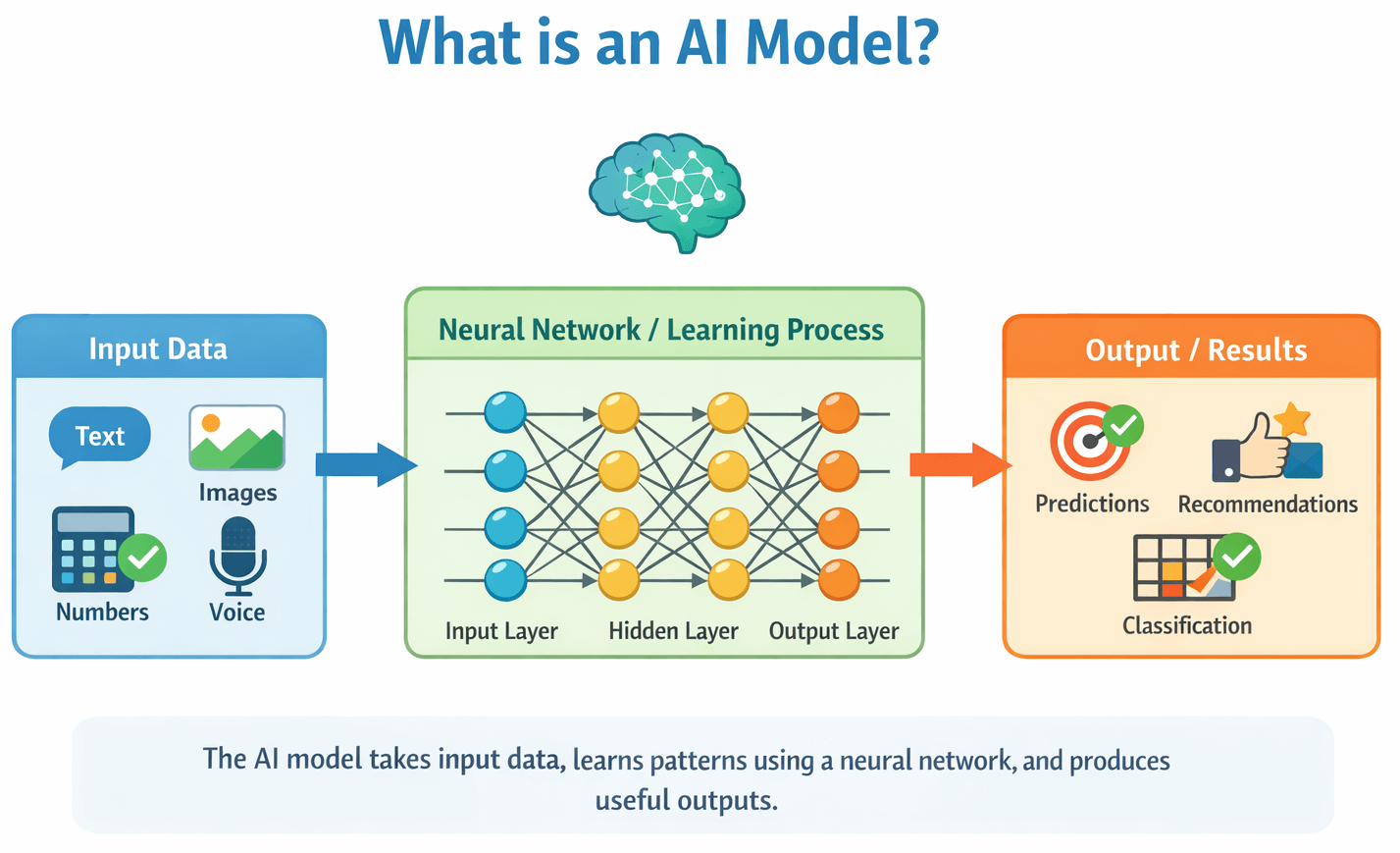
In simple words, an AI model is a system that
- takes input,
- learns patterns from data, and
- produces meaningful output.
Most modern AI models use neural networks, which are structures inspired by the human brain that help the AI learn complex patterns from data.
Think of it like a recipe: it has ingredients (input), instructions (internal logic), and a finished dish (output).
Example: A voice assistant like Siri uses an AI model to understand your spoken words (input) and give a reply or perform an action (output).
How AI Models Work: Inputs and Outputs
AI models process inputs — which could be text, images, numbers, or voice — and generate outputs like predictions, recommendations, or classifications. For example:
- Input: A photo of a cat
- Output: “This is a cat”
Training vs Inference
A key concept in AI models is training vs inference:
- Training: The model learns patterns from a large set of data. For instance, showing thousands of cat photos to help the model recognize cats.
- Inference: The model applies what it has learned to new data. For example, identifying a new cat photo it has never seen before.
Think of training as teaching and inference as using that knowledge in real life.
Use Cases of AI Models
- Healthcare: Predicting patient health risks
- Finance: Detecting fraud in transactions
- Retail: Recommending products online
- Customer Service: Chatbots answering queries
Even if you are a beginner, understanding AI models helps you grasp how technology works behind familiar tools like search engines, smart assistants, and recommendation systems.
Relationship with Other Topics
Understanding AI models connects you to broader topics like:
- Machine Learning: AI models are often built using machine learning
- Neural Networks & Transformers: Advanced AI models use these for complex tasks
- Vector Databases: Some AI models use these to quickly search large amounts of data
Audience-Specific Advice
If you’re a non-technical learner, focus on concepts, examples, and outputs rather than algorithms. Using simple real-world analogies like recipes, teachers, or problem-solving can help.
Pro Tips
- Start with simple AI models before exploring complex ones.
- Understand the difference between training and inference.
- Always connect the model to a real-world problem for clarity.
- Explore interactive AI tools online to see models in action.
What You Learned in This Post
- You now understand what an AI model is and how it works for beginners, including its inputs, outputs, and purpose.
- You learned the difference between AI model training and inference in simple, non-technical terms.
- We provided examples of AI models in real life, such as voice assistants, recommendation systems, and fraud detection.
- You gained a non-technical explanation of AI models using analogies like recipes and teachers to make the concept easier to grasp.